December 15, 2025 · 9 mins read
Santosh Kumar
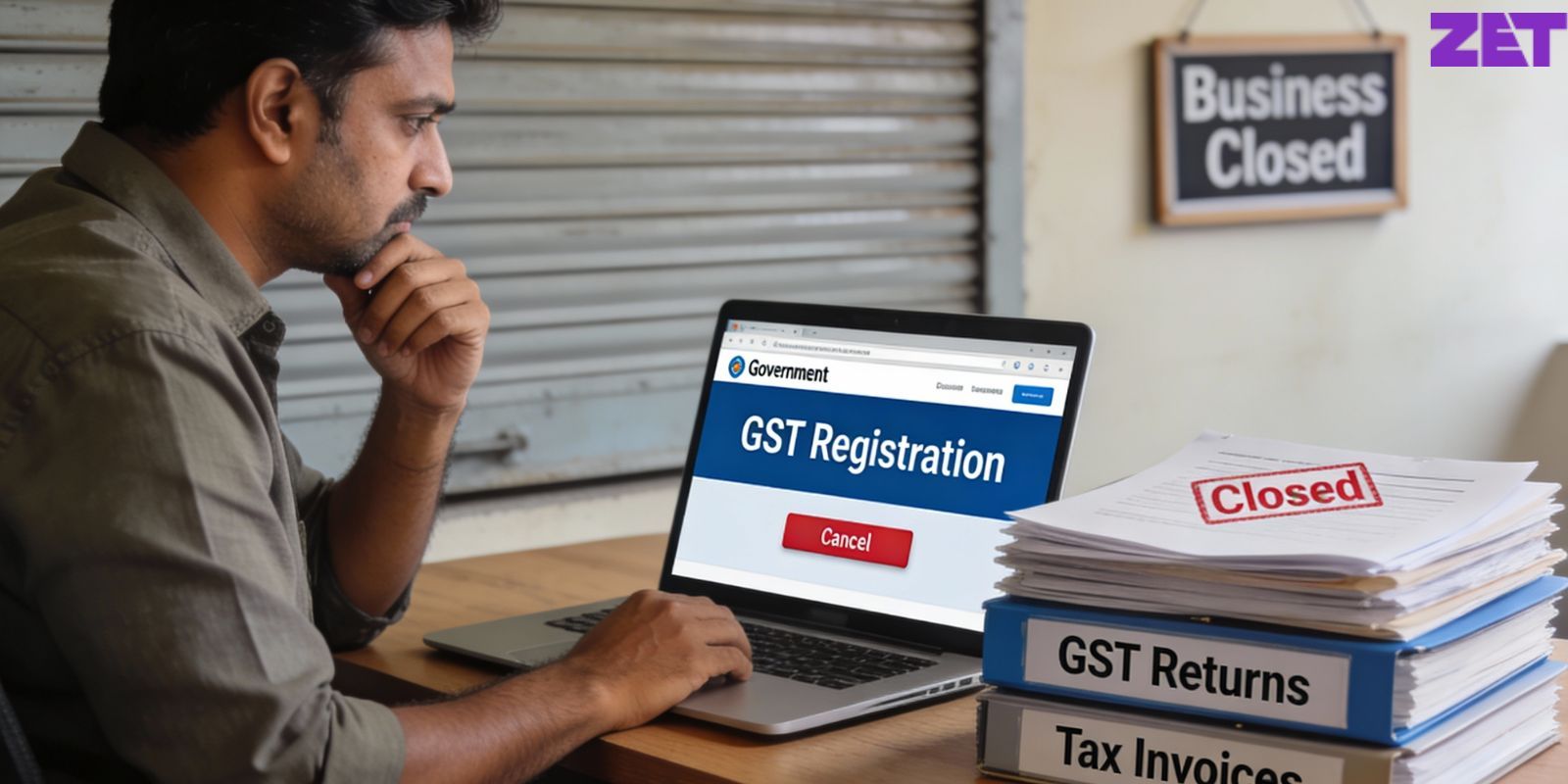
GST came into effect to simplify India’s indirect tax system, putting several taxes under one harmonised roof. For most businesses, a GST registration is mandatory. But there are also times when maintaining that registration is no longer needed – or even recommended. In such cases, understanding how to cancel GST registration becomes essential.

Cancelling a GST registration involves far-reaching consequences from a legal standpoint. Cancelling GST registration will greatly affect your compliance obligations, along with considerations for when to cancel, record-keeping requirements and obligations after cancellation. When you cancel GST registration, you can avoid penalties and administrative complications as a result of shutting down a business, merging or transferring the ownership of a business, or no longer being over the turnover threshold.
In addition, it can be difficult to find out exactly what you need to do to cancel the GST registration, what kind of requirements you will need to apply for cancelling your GST registration and what kind of pitfalls may exist through the application process. The goal here is to assist people with the cancellation of their GST registration in a smooth manner while remaining compliant with all appropriate laws during the transition.
GST registration cancellation is the process of legally deactivating a business’s GSTIN in the GST portal. When cancelled, the business is not obligated to collect GST, file returns or claim input tax credit. At the same time, however, the business also forfeits the entitlement to levy GST on its supplies.
The law provides for three categories of GST registration cancellation:
1: Voluntary cancellation, initiated by the taxpayer.
2: Suo motu cancellation, initiated by the GST authorities.
3: Cancellation for transfer, merger or change in business structure.
Also Read: Types of GST Registration in India
There are a number of scenarios when a company might decide to cancel its GST registration. Understanding them is the first step in determining if cancellation is right for you.
If the business has ceased and never intends to continue, holding onto the GST registration just adds to the compliance load. In these situations, elective cancellation is not just allowed, but recommended.
Companies often restructure, for example.
1: Merger with another company,
2: Transfer of ownership,
3: Demerger,
4: Conversion from sole proprietorship to partnership or vice versa.
These cases generally need a new GST registration for the new entity, whereas the old GSTIN has to be cancelled.
Not every business needs to be registered under GST. If the turnover is under the threshold prescribed for registration (which is different for goods and services), the business can apply for cancellation. This gets around the perpetual obligation to lodge nil or low activity returns.
Others went in for GST registration voluntarily. If such businesses determine that keeping the registration provides no benefit or raises compliance costs, they can cancel it.
With a sole proprietorship, the GST registration needs to be cancelled if the proprietor dies. The heir can carry on the business as a new GST registration, if necessary.
Cancellation may be initiated by the authorities if a registered individual.
1: Fails to file returns consistently,
2: Issues invoices without supply,
3: Violates GST rules,
4: Misuses the input tax credit.
In these instances, cancellation is mandated by law, but the taxpayer potentially has an opportunity to submit a response.
Also Read: Credit Card Renewal & Replacement
But before you embark on this mission, here are the implications:
1: The business cannot collect GST from customers after the effective date of cancellation.
2: ITC on any closing stock has to be reversed.
3: Any liability at the time of cancellation shall be relieved.
4: Filing of a final return (GSTR-10) becomes mandatory.
Ignoring these can invite fines, interest, or lawsuits.
The GST portal allows you to cancel GST registration completely online, without having to submit forms physically. Here is a simple explanation of how to cancel GST registration.
Access the GST portal and log in.
Navigate to Services → Registration → Application for Cancellation of Registration.
You will then select the relevant reason from a canned list, for example:
1: Discontinuation of business
2: Reduction in turnover
3: Transfer or change in constitution
4: Closure of business operations
Depending on the reason you select, the portal might request:
1: Details of stock lying in hand
2: Information about the transferee (in case of mergers or transfers)
3: Input tax credit involved
4: Relevant dates, such as the discontinuation of business
Documents include:
1: Closure letter or declaration
2: Merger documents
3: Transfer agreement
4: Death certificate (in case of proprietor’s demise)
5: Proof of business discontinuation
The list changes depending on which reason you choose.
The app must be authenticated through either
1: Digital Signature Certificate (DSC),
2: EVC (OTP sent to registered mobile and email),
3: Aadhaar-based authentication.
Once submitted, you’ll get an ARN – an Application Reference Number. You can use this to follow up on the cancellation request.
If everything is in order and no additional explanation is required, the tax officer approves the cancellation. A cancellation order is issued on the portal, and the GSTIN stands cancelled with effect from the said date.
Also Read: Credit Card Cash Advance
Dropping the registration doesn’t immediately conclude all compliance obligations. A few important steps remain:
Otherwise, a final return is due within 3 months of the cancellation or cancellation order, whichever comes later. This file contains information on inventory and associated tax due.
Any taxes, penalties or interest due should be paid prior to or while filing the last return.
GST records have to be kept for a minimum of 72 months (six years) as per law, even after cancellation.
It should not issue GST invoices, claim input tax credit or charge GST after the cancellation. Doing this can lead to punishment.
Also Read: Annual Fee vs Lifetime Free Cards
Sometimes taxpayers apply for cancellation because their business was temporarily suspended, they can’t afford it, or they don’t understand turnover. If the cancellation was initiated by the authorities rather than voluntarily by the taxpayer, the GST law allows for revocation of cancellation under certain conditions.
A revocation request must be received within the time period, together with any outstanding returns. Upon acceptance, GSTIN is restored.
But if cancellation were voluntary, revocation would not typically be allowed. A new filing would likely be necessary if the business ever got back up.
While the GST portal enables businesses to self-cancel GST registration, most of them stumble upon the process due to:
1: Requirement of correct documentation,
2: ITC calculations on closing stock,
3: Compliance with final return filing,
4: Legal interpretation of business transfer scenarios.
A tax or GST specialist will also make certain that the process is foolproof, thus minimising the chances of rejection or post-event issues.
For that, you need to file on the GST portal by clicking on ‘Application for Cancellation of Registration’, fill in the details, upload documents, verify the form and submit. The agencies afterwards approve the cancellation if all is in order.
Yes. If your turnover is below the legal limit for registration, you can request cancellation. This is also a typical GST cancellation cause.
Yes. Even after cancellation, you are required to file a final return (GSTR-10) within three months. Such a return accounts for inventory held and debts due as of cancellation.
Yes. For a sole proprietorship, the GST registration should be cancelled following the proprietor’s death. The successor can carry on the business under a new GSTIN if desired.
All unused ITC has to be reversed. You might also be liable for tax on the closing stock for the final return.
Revocation can be made only if the cancellation was made by the authorities. If you opt to cancel GST registration, you can’t turn it back on – you’d have to apply for a new registration if your business becomes eligible again.

Build and Maintain a 750+ Credit Score